Common Short-Term Rental Problems Aren’t Guest Problems
Most common short-term rental problems don’t start with bad guests — they start with friction.
Last winter, I had a guest call me from the front door in full ski gear.
Boots on. Goggles pushed up on their helmet. Gloves clipped to their jacket like they were about to summit Everest instead of enter a condo.
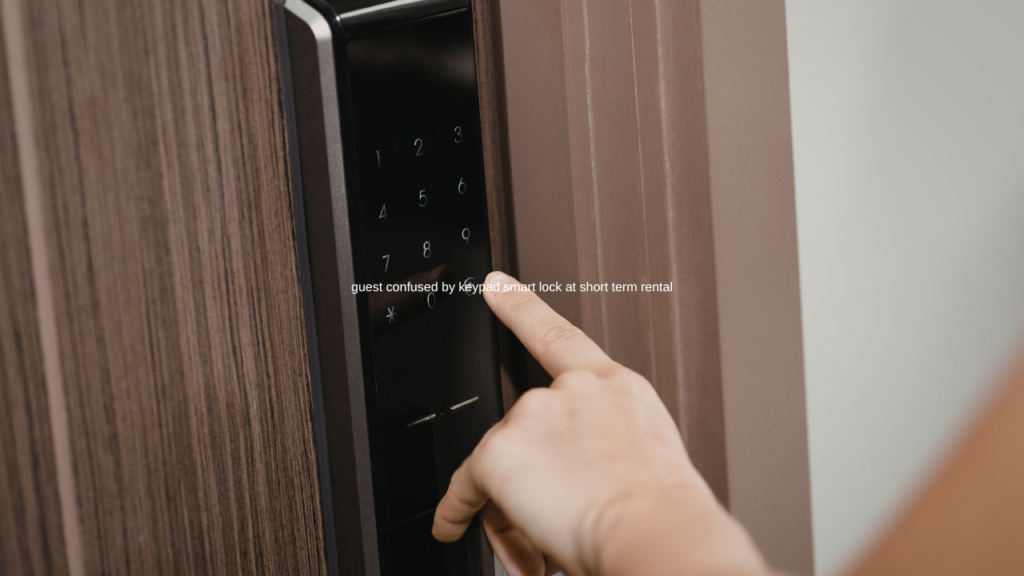
They were standing in front of what might be the most aggressively simple smart lock ever manufactured. Four numbers. One giant checkmark. That’s it. It looks like it was designed for toddlers and Labradors.
“I think it’s broken,” they whispered.
They had the code.
They were pressing the numbers.
It beeped.
Nothing happened.
Then they leaned forward and peered into the peephole like it was biometric recognition — like we were running a classified military installation instead of a two-bedroom rental.
Still nothing.
Then they waved their phone in front of the lock like it was a FastPass at the Magic Kingdom.
Because at that point, “we’re just trying technologies”.
I asked gently, “Did you press the check-mark?”
Silence.
Then: “There’s a check-mark?”
Door opens. Crisis over.
Now here’s the part most hosts skip:
That wasn’t a guest problem.
That was a systems problem.
Because if a tired traveler in ski boots is attempting bio-metric clearance and Disney-level entry protocols on a keypad, the issue isn’t intelligence.
It’s friction.
That moment perfectly sums up one of the most common short-term rental problems hosts face — and it’s not what most people think.
Most common short-term rental problems aren’t about difficult guests.
They’re about friction points no one engineered out.
The “Bad Guest” Narrative
When hosts talk about short-term rental challenges, the pattern is predictable:
“Guests don’t read.”
“Guests ignore house rules.”
“Guests expect five-star hotels for a mountain condo.”
“Guests message at 10:47 PM like it’s an emergency hotline.”
And to be fair — sometimes they do.
But hospitality has always worked this way.
Guests:
- Arrive tired.
- Skim instructions.
- Forget what you sent yesterday.
- Compare you to their last stay.
That’s not new. That’s human behavior.
What turns normal behavior into short-term rental problems is when the operation depends on perfect attention.
If you’re just starting to think about hosting this way, read Why Even One Short-Term Rental Needs Systems first.
If your system requires ideal guests, it’s fragile.
If it anticipates distracted ones, it’s strong.
That’s not blame.
That’s leverage.
Communication Gaps Create Conflict

One of the most common short-term rental problems is repeated guest confusion.
They ask where to park — even though it’s “in the listing.”
They can’t find the trash bins — even though you “sent that already.”
They miss quiet hours — even though it’s “in the house manual.”
Of course it’s in the house manual.
So is the WiFi password, appliance instructions, and the life story of your hot tub.
Guests are not studying for an exam.
They are arriving.
If check-in instructions require scrolling, they will get missed.
If critical rules are buried in paragraphs, they will feel optional.
Strong short-term rental systems assume skimming.
So they:
- Time messages intentionally.
- Repeat high-risk details.
- Format for clarity.
- Reinforce expectations at key moments.
When communication is engineered, questions drop.
Not because guests became better.
Because friction got removed.
Undefined Standards Create Turnover Stress
Another common short-term rental problem?
Inconsistent experiences.
One guest says “spotless.”
The next says “mostly clean, just a few small things.”
Those “few small things” are where revenue leaks.
Cleaning restores hygiene.
Standards restore experience.
If your turnover process lives in a text thread that says,
“Hey, just make it look great like last time 😊”
You don’t have standards.
You have vibes.
And vibes shift.
Without:
- Documented staging expectations
- Clear restock levels
- Defined reset procedures
- A quality control checkpoint
Every turnover becomes interpretation.
Interpretation becomes drift.
Drift becomes four-star reviews that say, “Everything was good!”
Which is the most financially dangerous sentence in hosting.
Lack of Documentation Creates Panic and Pressure
Here’s a short-term rental challenge that doesn’t get talked about enough:
Founder bottleneck.
You know:
- The breaker panel trick.
- The WiFi reset ritual.
- Which remote controls the fan and which one you just stuck in a drawer because its a back up to something or other.
- Which guest messages require escalation.
You carry it in your head.
That works… until you want a day off.
Memory-based hosting feels efficient — until something breaks at 9 PM and you’re walking someone through troubleshooting from a grocery store aisle.
Documentation doesn’t eliminate problems.
It eliminates improvisation.
When systems are written, delegated, and repeatable:
- Response time shortens.
- Stress drops.
- Decisions become consistent.
That’s not corporate overkill.
That’s operational maturity.
The Operator Mindset Shift
At some point, every host faces this question:
“Why does this feel harder than it should?”
That question is the pivot.
Reactive thinking asks:
“Why are guests like this?”
Operator thinking asks:
“Where is the friction point?”
You cannot control guest personality.
You can control:
- Expectation clarity.
- Message timing.
- Turnover standards.
- Documentation.
- Escalation paths.
When those are structured, most common short-term rental problems shrink.
Not because guests changed.
Because your operation stopped depending on luck and hoping everything will go “just pefectly”.
When the System Is Strong, Problems Shrink
At some point, every host asks:
“Why does this feel harder than it should?”
That question is the pivot.
Reactive hosting asks:
“Why are guests like this?”
Operator hosting asks:
“Where is the friction point?”
You can’t control guest personality.
You can control:
- Expectation clarity
- Message timing
- Turnover standards
- Documentation
- Escalation paths
When those are structured, most common short-term rental problems stop feeling personal.
They start feeling solvable.
And solvable is powerful.
When the System Is Strong, Problems Shrink
Strong systems don’t eliminate human behavior.
They absorb it.
Guests will still:
- Forget the check-mark.
- Ask about WiFi.
- Miss a detail.
- Compare you to a resort.
But with defined short-term rental systems in place:
Check-ins smooth out.
Turnovers stabilize.
Reviews become consistent.
Your stress drops.
And consistency is what protects pricing.
That’s the part no one says out loud.
If your operation feels chaotic, your rates will eventually reflect it.
Structure isn’t corporate.
It’s profitable.
Common short-term rental problems aren’t about difficult guests.
They’re about friction you haven’t engineered out yet.
Blame feels good.
Systems build leverage.
Most hosts are running one system.
Professional operators run five.
And leverage is what turns hosting from exhausting to scalable.
If you’re ready to stop reacting and start operating, the next step isn’t working harder.
It’s identifying the core systems your rental actually needs.
Because cleaning is only one of them.
And that’s where control — and real profitability — begins.
Here’s what those five systems actually look like: The 5 Core Systems Every Short-Term Rental Needs.
Get practical short-term rental systems and hosting insights.
